About University
About University

Cradled in the lap of mountains at the foothills of auspicious Trikuta, besides the river Tawi at an altitude of 1030 ft. is Jammu. This 'city of temples' has many places...

Cradled in the lap of mountains at the foothills of auspicious Trikuta, besides the river Tawi at an altitude of 1030 ft. is Jammu. This 'city of temples' has many places...



One of the emerging challenges faced by any higher educational institution is the development, application and maintenance of quality...
JU Hosts Public Lecture on “Kautilya’s Philosophy on Social and Economic Welfare”
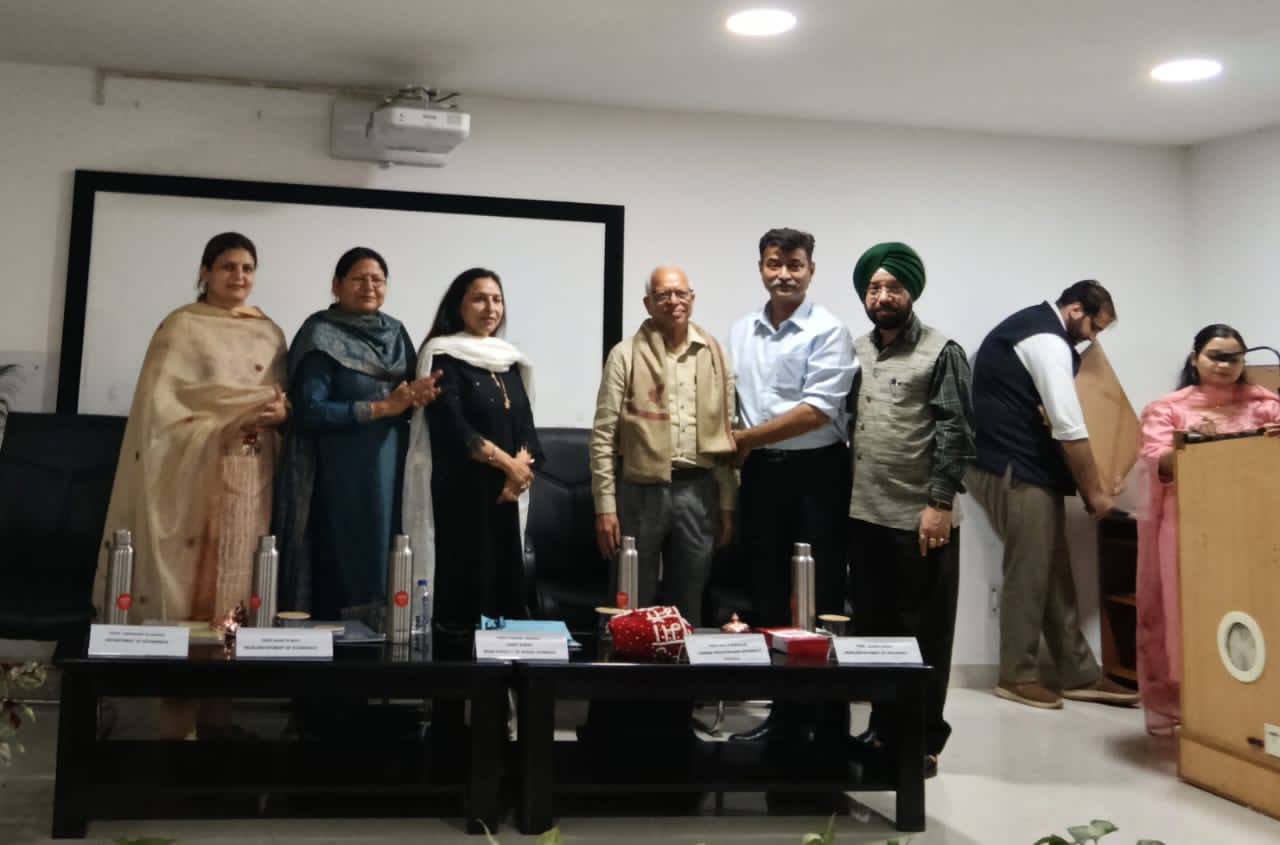
Jammu, April 22, 2026: The Department of Economics and the Department of Philosophy, University of Jammu, jointly organised a public lecture on “Kautilya’s Philosophy on Social and Economic Welfare” today.
Prof. Raj K. Mahajan from Punjabi University, Patiala, was the key speaker on the occasion. In his lecture, he explained the Varna System and Āshrama System, describing them not merely as social classifications but as ethical frameworks designed to organise duties, responsibilities, and stages of human life in harmony with social welfare and spiritual growth.
Moving towards a comparative analysis, he contrasted Western Economic Thought with Indian Economic Thought. He observed that Western economics largely developed around individual self-interest, competition, and accumulation of wealth, whereas Indian economic philosophy integrates moral responsibility, social balance, and collective well-being. Prof. Mahajan further stated that Indian economic thought has often been misunderstood due to its ethical and philosophical grounding.
Through textual analysis, Prof. Mahajan argued that Kautilya may rightly be regarded as the Father of Economics rather than Adam Smith, highlighting Kautilya’s advanced ideas on taxation, fiscal responsibility, welfare administration, and economic regulation. He explained that Kautilya’s taxation system was based on proportionality and welfare orientation, ensuring state revenue without exploiting citizens.
The lecture also drew attention to progressive social policies described in Kautilya’s Arthashastra, including provisions allowing women to work from home, which he interpreted as an early indicator of women’s empowerment within administrative structures. He further observed conceptual similarities between Keynesian economic thought and Kautilya’s emphasis on state intervention and welfare-oriented governance.
Prof. Suman Jamwal, Dean, Faculty of Social Sciences, was the Chief Guest. In her presidential address, she highlighted the historical depth and intellectual relevance of Kautilya’s writings. She stated that discussions on governance, justice, and statecraft must begin with philosophical reflection, as philosophy provides normative direction to all disciplines. She emphasised that philosophy is not merely abstract speculation but a guiding framework shaping social sciences, policy-making, and ethical governance, identifying ethical governance as the central spirit of Kautilya’s Arthashastra.
Earlier, Prof. Sunita Devi Sharma, Head, Department of Economics, presented the formal welcome address, while Prof. Jasbir Singh, Head, Department of Philosophy, introduced the key speaker to the audience.
The programme concluded with a vote of thanks delivered by Prof. Virendra Koundal, who reflected upon Kautilya’s role as a teacher during the Nanda dynasty. He narrated how, upon witnessing unworthy leadership, Kautilya resolved to nurture and establish a capable ruler, thereby demonstrating the transformative responsibility of teachers in shaping society and governance, while also cautioning against misconceptions regarding the role of a teacher.
The lecture was attended by faculty members, research scholars, and students from various departments. The event successfully fostered interdisciplinary dialogue, reaffirming the continuing relevance of Indian Knowledge Systems and philosophical insights in addressing contemporary social, economic, and ethical challenges.