About University
About University
Cradled in the lap of mountains at the foothills of auspicious Trikuta, besides the river Tawi at an altitude of 1030 ft. is Jammu. This 'city of temples' has many places...

Cradled in the lap of mountains at the foothills of auspicious Trikuta, besides the river Tawi at an altitude of 1030 ft. is Jammu. This 'city of temples' has many places...



One of the emerging challenges faced by any higher educational institution is the development, application and maintenance of quality...
University of Jammu Organises Maiden Educational-cum-Field Study Tour to Ladakh
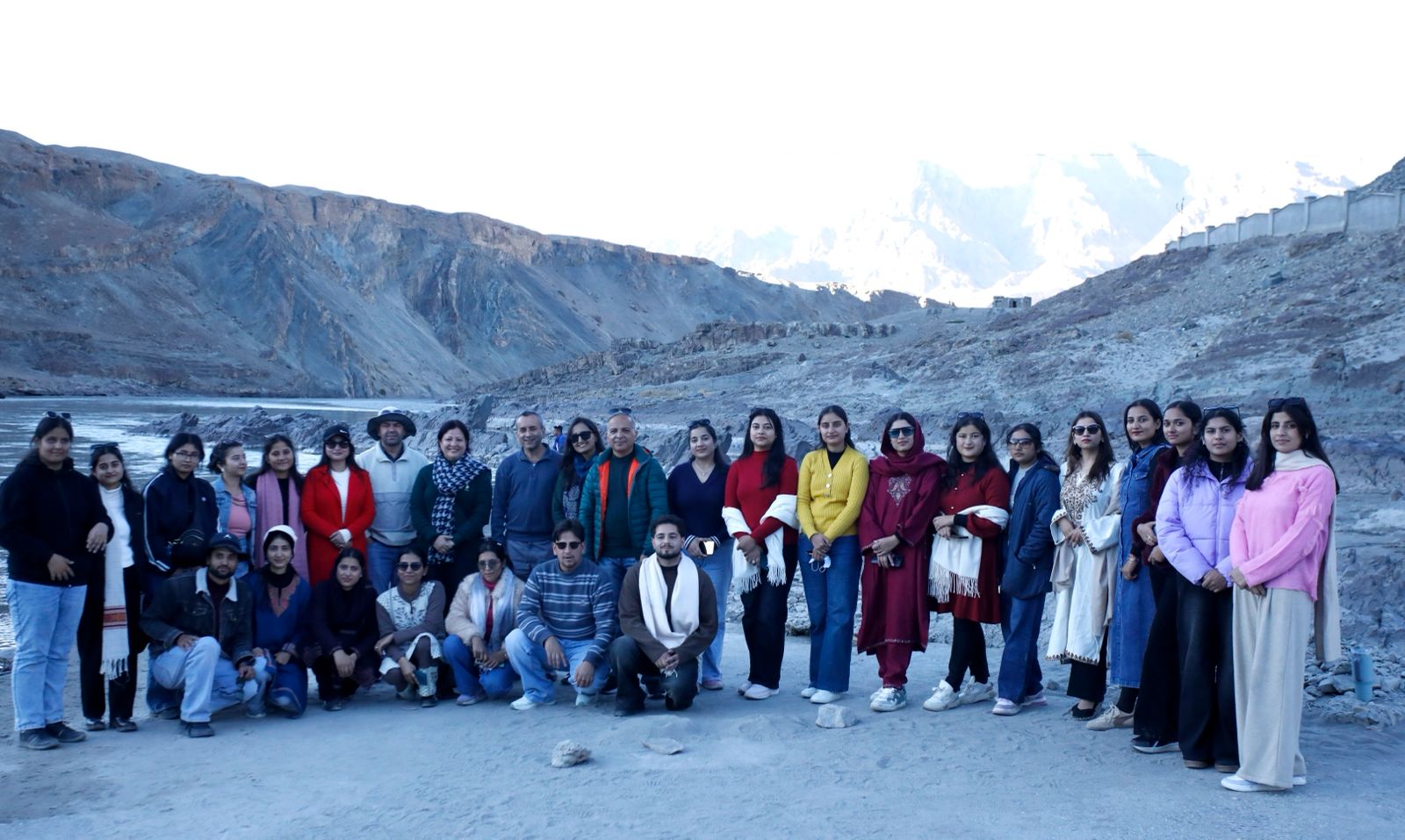
October 30: The Department of Environmental Sciences, University of Jammu, organised a nine-day educational-cum-field study tour to Ladakh, marking its maiden academic field visit to the Trans-Himalayan region. The tour was undertaken by a team of 32 students and research scholars, accompanied by faculty members of the department, covering the Jammu-Srinagar-Leh route.
The field visit aimed to provide students with first-hand exposure to the remarkable environmental and ecological transitions across five distinct physiographic zones, namely the Shiwaliks, Lesser Himalayas, Kashmir Valley, Greater Himalayas and Trans-Himalayas. The journey offered valuable opportunities to study diverse landforms, vegetation patterns, elevational gradients and associated variations in aquatic and terrestrial biodiversity, bringing together a range of Himalayan ecosystems within a single academic expedition.
Although most students were familiar with the Kashmir Valley, crossing the challenging high-altitude Zoji La Pass provided an entirely new learning experience. During the ascent, students observed the gradual transition in vegetation communities with increasing elevation, culminating in distinctive Betula patches near the pass. Beyond Zoji La, the landscape opened into the vast and rugged Trans-Himalayan terrain. The team travelled through Drass, one of the coldest inhabited places on Earth, before reaching Kargil, where they visited the Kargil War Memorial and paid homage to the brave soldiers who made the supreme sacrifice in the service of the nation.
The onward journey from Kargil to Leh offered spectacular views of the expansive valleys of Khangral and Budhkhurbu, deep gorges and the renowned mountain passes of Namika La and Fotu La. During the journey, Dr. Suresh Kumar introduced students to the GLORIA (Global Observation Research Initiative in Alpine Environments) protocol and explained the remarkable ecological adaptations that enable plants to survive the harsh climatic conditions of high-altitude cold deserts.
The team also visited Sangam, the spectacular confluence of the Indus and Zanskar rivers. On the occasion, Prof. Deepika Slathia, Head of the Department, familiarised students with the physicochemical characteristics and biological attributes of these high-altitude river systems, highlighting the ecological processes governing their distinctive aquatic environments. On their return, the team also visited Gurudwara Pathar Sahib, a revered spiritual landmark of the region.
The visit to Nubra Valley provided students an opportunity to explore its distinctive cold-desert landscape, characterised by expansive sand dunes and the iconic double-humped Bactrian camels. Dr. Neeraj Sharma, Teacher In-charge of the tour, briefed the students on the valley's geographical, historical and strategic significance, highlighting its proximity to the Siachen Glacier and explaining its importance in the broader geopolitical context.
A major highlight of the excursion was the visit to Tso Kar Lake, one of Ladakh's characteristic high-altitude brackish lake ecosystems and an important habitat for the Black-necked Crane, the Union Territory bird of Ladakh. The students were fortunate to spot four pairs of these magnificent birds at three different locations. In a particularly remarkable wildlife encounter, a Tibetan fox was observed chasing a pair of Black-necked Cranes, providing a rare opportunity to witness predator-prey interactions in a fragile Trans-Himalayan ecosystem.
The team also spotted and photographed a small herd of Blue Sheep (Bharal) near Tanglang La Pass, followed by a large herd of Tibetan Wild Ass (Kiang) roaming across the expansive plains of Tso Kar. These wildlife sightings offered students valuable insights into the region's rich and distinctive biodiversity.
Accompanied by Prof. Piyush Malaviya and Dr. Anshu Gupta, the students also explored Ladakh's rich cultural and historical heritage through visits to local monasteries, museums, Shanti Stupa and Sindhu Ghat. Another significant highlight was a photo exhibition showcasing the remarkable biodiversity of Ladakh, organised in conjunction with the Wildlife Week celebrations at the main market. The exhibition provided students an opportunity to appreciate the region's rich natural heritage and the remarkable biodiversity of the Trans-Himalayan ecosystem.
The educational-cum-field study tour provided an immersive academic experience, enabling students to connect classroom concepts with real-world ecological processes while developing a deeper understanding of the environmental, biological, cultural and strategic significance of the Trans-Himalayan region.