About University
About University
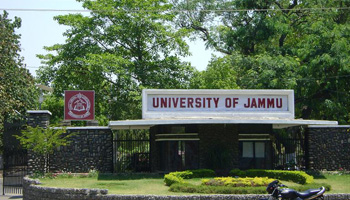
Cradled in the lap of mountains at the foothills of auspicious Trikuta, besides the river Tawi at an altitude of 1030 ft. is Jammu. This 'city of temples' has many places...
Cradled in the lap of mountains at the foothills of auspicious Trikuta, besides the river Tawi at an altitude of 1030 ft. is Jammu. This 'city of temples' has many places...



One of the emerging challenges faced by any higher educational institution is the development, application and maintenance of quality...
The first session of in an ongoing Science festival titled ““Vigyan Sarvatra Pujyete” commenced with lecture by Dr. T.P. Singh, research scientist at All Indian Institute of Medical Sciences, New Delhi. Prof Rajni Kant, Director, College Development Council and Convener of National Science Day celebration at University of Jammu introduced speaker to the audience and in detail gave a profile of Dr. T.P Singh known for his work in the fields of Rational Structure-based drug design and Protein Structure biology and X-ray crystallography. Prof Rajni Kant said that Dr Singh played an active role in the development of drug design in the fields of Antibacterial therapeutics, Tuberculosis, Inflammation, Cancer and Gastropathy. Prof Rajni Kant further said that he is the first Indian to receive all the six Ramachandran awards of the country. The speaker delivered a lecture on the topic “Structure and functions of innate immunity protein and discovery/ design of anti-viral (Sars-COV2) agents. He explained in detail the role of X-ray crystallography in determining the 3d-structure of protein of the immune system. In his talk he also appraised the students and scholars with the structures of corona virus and different ways to fight microbial infection i.e., by immune system or through use of drugs. In the immune system, innate/ adaptive immune system proteins are targeted for drugs designing The speaker depicted the pathway leading to conversion of iodide ion into hypoiodites and nitric oxide to nitrite. He also emphasised that person containing more iodides and nitric oxide are likely to have more immunity. Also compare iodine consumption with COVID-19 infection. The second session was presided over by Prof. Sat Pal Sharma, Department of Chemistry, University of Jammu, Jammu. The speaker of this session, Dr. Jag Paul Sharma, President SIDAVER, Former Director Research, SKUAST, Jammu delivered a lecture on the topic “Indian Agriculture (Crop, Horticulture and Animal Sciences): By 2030 and Beyond”. The speaker apprised the audience that the Indian agriculture system, while leading in production of food grains, horticultural products, sugar cane, milk and fish, faces several future challenges. These include increase in human population, climate change, changing consumers, preferences and staying resilient against global socio-economic factors. The speaker also highlighted shortcomings of Indian Agriculture such as small and scattered lands, hurdles in mechanisation and marketing, lack of awareness about marketing prospects, inadequate storage facility, meagre investment and mostly cereal based cropping patterns. He emphasised the need to equip the agriculture system with innovative technologies which can lead to more production and climate resilience. He also apprised the audience about some startups dealing with agriculture such as Bijak, Ninjacart, Agrocart, Dehaat, Village agro. Some innovative technologies covered by him include farm automation, precision agriculture, laser scare crows, harvest quality vision and vertical farming. Finally, the talk concluded with future issues and challenges in the domain. Professor Meena Sharma, Dean Planning and Prof. Kamal Kapoor presented a memento to the invited speaker. A vote of thanks was proposed by Prof. Sat Pal Sharma.