About University
About University
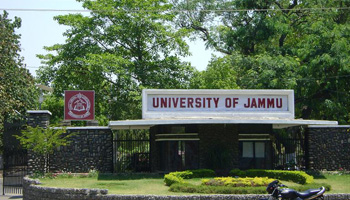
Cradled in the lap of mountains at the foothills of auspicious Trikuta, besides the river Tawi at an altitude of 1030 ft. is Jammu. This 'city of temples' has many places...
Cradled in the lap of mountains at the foothills of auspicious Trikuta, besides the river Tawi at an altitude of 1030 ft. is Jammu. This 'city of temples' has many places...



One of the emerging challenges faced by any higher educational institution is the development, application and maintenance of quality...
DNA is a master molecule carrying the blueprint of life and how a single variation in the DNA sequence can lead to genetic abnormality, bringing havoc in the life of an individual said Prof Manoj K Dhar,Vice-Chancellor, University of Jammu while delivering lecture on “Understanding Rare Genetic Diseases.” Prof. Rajni Dhingra, Dean Research Studies, University of Jammu introduced the speaker to the audience and gave a detailed profile of Prof Manoj K. Dhar, Vice Chancellor, University of Jammu who is known for his significant contribution in understanding the genetic basis of rare genetic disorders in humans. He is the member of several National Committees in DST, DBT and SERB, etc. Prof Dhingra further said that Prof Dhar is a fellow of two prestigious Science Academies of the country namely National Academy of Sciences, India and National Academy of Agricultural Sciences. He has been awarded many prestigious awards and honours. Prof. Dhar has established a strong research group on Genome Research in the University of Jammu. His research group has made significant contribution to genomics of several horticultural crops of high value and relevance to J & K. Prof Dhar in his lecture on the 4th day of National Science Week celebration in University of Jammu said that there are more than 6000 rare diseases which are affecting approximately 300 million people worldwide. He informed that in India a disease is called Rare Disease (RDs) if it affects 1 in 5000 individuals and approximately 50% RDs occur in childhood. He emphasized that J&K is inhabited by 8 major ethnic groups which are highly endogamous and consanguineous, increasing the risk of developing Rare genetic Disorders in the populations of J&K. Prof. Dhar informed that work done by his team has helped in genetic characterization of a musculoskeletal disease called as Progressive Pseudo rheumatoid Dysplasia (PPD) in Aria village of Poonch. Another genetic characterization work is being carried out in the village Dhadkai (Doda) and Paralkoat, where many people are suffering from hearing loss and Muteness. A short video of 20 minutes was shown which highlighted the contribution of H. J. Bhaba in the field of Atomic and Nuclear Energy. The second Session started with the introduction of the invited speaker, Dr. Summet Gairola, Sr. Scientist CSIR- Indian Institute of Integrative Medicine (IIIM), Jammu by Prof. Meena Sharma, Dean Planning and Development, University of Jammu,on the 4th day of National Science Week celebration in University of Jammu. Dr. Sumeet Gairola while speaking on the title “History and Scientific Contributions of CSIR-IIIM, Jammu” stated that CSIR-IIIM Jammu, is one of the 38 CSIR laboratories across India. The CSIR Laboratory (formally known as RRL) was established by Sir Col. R.N Chopra in the year 1941 and it is presently known as IIIM- Jammu (since 2007). Sir Col R.N Chopra was instrumental in the establishment of CDRI-Lucknow and was the Founding president of Pharmacological Society of India. The focus area of IIIM is to have an International Competitive Center of Natural products driven Drug discovery and integrating modern biology with chemistry. The Societal outreach programme includes cultivation of medicinal and aromatic crops for better income and livelihood to rural, poor and employment generation is the main focus of the Lab. The institute also has a Janaki Ammal Herbarium which is currently having 26,600 specimens, 3254 species and genera, majority of them are from Himalayan Region. The speaker informed that the Lab also has a crude drug repository, and facility for bioprospecting of microbial species, NABL accredited QC and QA facility. Dr. Gairola highlighted that IIIM has the only Drug testing laboratory in J&K, a GLP standard Animal House Facility and a Technology Business Incubation Centre. He stated that the Lab is involved in development of saffron based nutraceutical products, Cannabis cultivation based drug development and bringing purple revolution in the Bhaderwah, Doda region of J&K.