About University
About University

Cradled in the lap of mountains at the foothills of auspicious Trikuta, besides the river Tawi at an altitude of 1030 ft. is Jammu. This 'city of temples' has many places...

Cradled in the lap of mountains at the foothills of auspicious Trikuta, besides the river Tawi at an altitude of 1030 ft. is Jammu. This 'city of temples' has many places...



One of the emerging challenges faced by any higher educational institution is the development, application and maintenance of quality...
University of Jammu organized an awareness workshop on “Cyber Crimes against Women: Emerging Challenges and Legal Framework” held at Central University of Jammu, Rahya Sucheni, Samba.
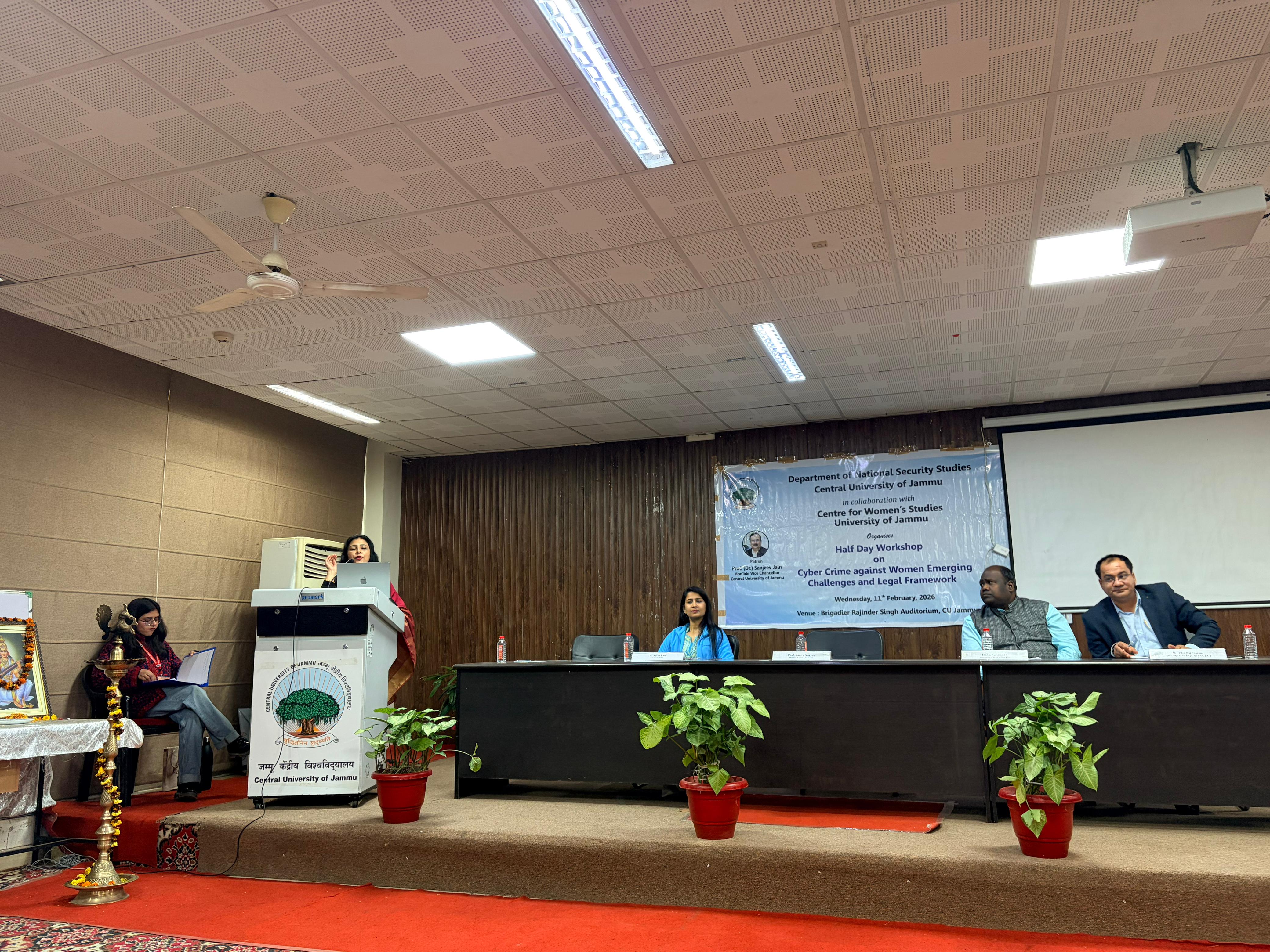
Jammu, February 11, 2026: The Centre for Women’s Studies (CWS), University of Jammu, in collaboration with the Department of National Strategic Studies, Central University of Jammu, organized an awareness workshop titled “Cyber Crimes against Women: Emerging Challenges and Legal Framework” at Brigadier Rajinder Singh Auditorium, CUJ, Rahya Sucheni, Samba, on February 11, 2026. The workshop aimed to sensitize students, researchers, and faculty members to the growing threat of cyber crimes targeting women and to enhance understanding of the existing legal mechanisms to address such challenges.
The keynote speaker for the workshop was Prof. Savita Nayyar, Director, Centre for Women’s Studies, University of Jammu. She began her address by expressing her gratitude to Prof. Umesh Rai, Vice-Chancellor, University of Jammu, and Prof. Sanjeev Jain, Vice-Chancellor, Central University of Jammu, for providing the opportunity to interact with the students, scholars, and faculty members of the Department of National Security Studies. Prof. Nayyar elaborated on the evolving nature of cyber crimes against women, including online harassment, cyber stalking, identity theft, and misuse of digital platforms. She professed that while digital technologies have created new opportunities for empowerment and expression, they have simultaneously given rise to complex forms of cyber crimes, disproportionately affecting women. Cyber crimes against women represent a serious and growing concern, as they often combine technological abuse with deep-rooted gender inequalities.
She also discussed the legal framework available in India to address cyber offences, including the Information Technology Act, 2000, and relevant sections of the Bhartiya Nyaya Sanhita. Laws relating to online harassment, defamation, obscenity, privacy violations, and identity theft provide a legal framework for redressal. However, she acknowledged that effective implementation remains a challenge due to underreporting, lack of awareness, procedural delays, and limited gender sensitivity within enforcement mechanisms. She emphasized the importance of reporting mechanisms, digital literacy, and collective responsibility in creating safer online environments for women. She added that addressing cyber crimes against women requires a multi-dimensional approach involving legal reforms, technological safeguards, institutional accountability, and societal change. Further, she concluded that ensuring cyber safety for women is integral to achieving gender justice and inclusive digital development. A collaborative effort among policymakers, academic institutions, civil society, and individuals is essential to effectively combat cyber crimes and uphold the dignity and rights of women in the digital world.
Dr. Neeta Rani, Head, Department of National Security Studies, Central University of Jammu, also emphasized the growing relevance of addressing cyber crimes against women in today’s digital era. She underscored the need for awareness, legal literacy, and collective responsibility, and expressed her hope that this workshop will contribute meaningfully to building a safer and more responsible digital environment. Dr. R. Sudhakar, Associate Professor, CUJ, delivered the welcome address.
Earlier, Dr. Disha Sharma, faculty member, Centre for Women’s Studies, University of Jammu, provided the introductory context, highlighting the increasing vulnerability of women in digital spaces and emphasizing the need for awareness, education, and institutional support to combat cyber crimes effectively.
A large number of students, scholars, and faculty members actively participated and engaged in discussions on contemporary cyber threats, preventive strategies, and the role of academic institutions in fostering cyber awareness and gender-sensitive digital practices. Many questions were asked by faculty members, including Dr. R. Sudhakar and Prof. M. Venkataraman, as well as students, which were answered by the resource person to their satisfaction.
The programme concluded with a vote of thanks delivered by Dr. Saranjit Kaur, faculty member, Centre for Women’s Studies, who thanked the keynote speaker, organizers, participants, and collaborating department for their valuable contributions and support in making the workshop a meaningful and impactful initiative. She also acknowledged the coordinators, Dr. Tilak Raj Sharma, faculty member and organizing secretary, CUJ, and Dr. Disha Sharma, faculty member, Centre for Women’s Studies, for the successful completion of the event